

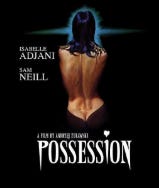
Possession was released in 1981 and written and directed by Andrzej Żuławski. The co German and French production stars Sam Neil as Mark and Isabelle Adjani as Anna, who won best actress at the Cannes Film festival for her role,
Despite the title, this movie is not your typical possession style horror movie. You know what I mean some demonic entity possesses someone and some old Catholic priest has to come to the rescue to vanquish the evil demon back to Hell.
No, Possession on the surface a marriage drama with elements of psychological horror, creature feature, body horror, eroticism and supernatural horror. All with the setting of Cold War era West Germany.
Mark and Anna are an estranged couple whose marriage is falling apart due to external forces one cannot explain, The performances by Niel and Adjani are among the best ever in the genre.
For this character analysis, my guest co-contributor, Summoning Spirits, will write about Mark, while I write about Anna.
I hope everyone enjoys it and if you haven’t done so yet subscribe to:
Anna’s War
By Josh aka Horror Hangouts
While her husband, Mark, who is a West German government agent, is away from home fighting the Cold War, Anna is home fighting her own war. But this isn’t a war against another country or an opposite political ideology. The war Anna is fighting is a war over her soul, her womanhood and her humanity.
When you have a couple, where one of the partners is away from home due to their occupation, it may be inevitable that the relationship begins to deteriorate. No matter how much love there once was, eventually one if not both the parties will get bored and lonely. Then resort to having an affair. Which initially happens to Anna.
We do not know for sure but can assume that Anna and Mark at one time had a strong relationship that blossomed into a marriage that gave them a son named Bob. But at some point, the loneliness and isolation was too much for Anna and while Mark was away she meets new age guru of sorts named Heinrich. Heinrich is eccentric and bizarre but a welcomed breath of fresh air for Anna, who is probably excited by the thrill that Heinrich can offer. We might assume that eventually Anna would tire of Heinrich and call off the affair. After all Heinrich is hardly stable. Could he be a good father to Bob or even a good husband to Anna? It’s possible she may have done just that but for other reasons. Reasons and actions that even Anna could not control. Somewhere along the way another party makes its presence known and takes complete control of Anna in the form of a grotesque creature residing in an abandoned apartment building.
This creature, which looks like a cross between the blob and an octopus, has somehow taken control of Anna’s actions as well as her body and soul. This creature can force Anna into unspeakable things like fornication with the creature and even committing murder on its behalf, all be controlling Anna’s mind and thoughts. We don’t know where this creature comes from or when it gained control of Anna, and we really don’t need to know. The beauty of this film is it forces us to fill in the blanks which actually adds to the horror of the situation.
The terror of this creature isn’t its gruesome appearance but the fact it can use some form of telepathy to control its victims. Even more terrifying is it’s motives and end game. A game we are unaware of until the end of the movie. At some point it manages to take a hold of Anna, and this is where Anna’s grueling war starts. A war that not only drains her physically but emotionally as well.
Anna might not fully understand this creature, but she understands how dangerous this beast is. I believe this is why Anna states to Mark upon his return from his mission, that she wants a divorce. It is not that she hates Mark or has even stopped loving him, quite the opposite really. By attempting to push Mark and her son away, she is protecting them. She fears this creature could gain control of her husband and son.
Anna’s constant erratic behavior isn’t really her acting insane but fighting two different wars. She is fighting to save her soul and who she was by trying to fight the creature. The other war is fighting her feelings for her family. I believe she loves Mark very much which is why at times she is cruel, cold and indifferent to him most of the movie. But a person can only hide their true feelings for so long. Which is why there a times she does give in to her feelings for Mark and at one point confides in him what it is that has taken control of her.
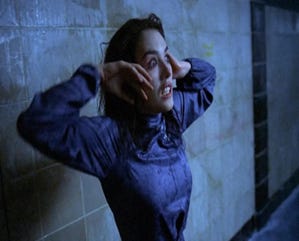
Which brings us to the defining moment of the movie. The scene in the subway where this war reaches it’s peak. If there is a more intense or disturbing scene in horror, given that the scene lasts several minutes, I fail to think of another scene that compares.
The scene involves a convulsing Anna thrashing and screaming. She is losing all control of her body as the violent flailing continues with no end in sight. Exhausted, Anna drops to her knees vomiting a white milky substance from her mouth right before a pool of blood emerges from between her thighs which appears to be a miscarriage or as Anna called it a ‘miscarriage of faith’.
Many people have speculated what this scene really means. Some may say it is symbolic of Anna aborting her marriage to Mark. Many others say it is symbolic of women’s struggle against the patriarchy. Which makes sense. Conform and bend to its will or be replaced. This happens to both Anna and Mark. Earlier in the movie Mark meets his son’s teacher, Ellen, who happens to be a spitting image of his wife and reminds Mark of what his wife used to be like. We can assume this creature created Ellen as a doppelganger to Anna. The same thing happens to Mark as the creature creates a doppelganger of Mark at the end of the movie. That doppelganger returns to Mark and Anna’s apartment and unites with Ellen. Sensing this is all wrong, Bob drowns himself in the bathtub. This is another scene that one could do a deep dive in, no pun intended.
But I am getting ahead of myself. When I look at this gruesome sequence, I observe a woman fighting for her soul as well as her life. In the process she is also fighting to save her family. This creature has been at war with her for some time and this is Anna’s last stand. Does she win or lose? At the time perhaps she gets a win, however short lived it may have been. After the event she does confide in Mark about the incident. Instead of being revolted by her story, Mark becomes more supportive and for the final act of the movie, the couple become a unit once again. Granted not in the usual or traditional sense but these are unusual circumstances they are facing.
It could be said that the creature wins in the end. It accomplishes its goal creating a doppelganger of both Mark and Anna. To what end? We are not sure. Despite Anna and Mark dying at the end. The creature may have broken their bodies but fell just a bit short breaking their spirits, especially Anna. In the end Anna rediscovered herself. It might have been too late, but it serves as a moral. Some battles we cannot win and we might even lose our own identity for a time but if we find ourselves again like Anna, we will eventually win the war.
Death of the Self: A Gothic Analysis of Mark in
Zulawski’s Possession By Summoning Spirits
Horror is a fearless genre. It’s not afraid to romance societal taboos and encourage
our deathless search for the sublime. In Zulawski’s 1981 masterpiece Possession,
horror arises not solely from the supernatural but from the terrifying instability of
human identity. The film unfolds against the decaying architecture of divided Berlin,
a setting that mirrors the emotional and psychological disintegration of its
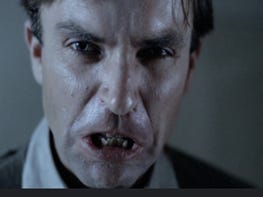
characters. At the center of this collapse stands Mark, played by an impassioned Sam
Neill, whose life unravels after returning home from a mysterious espionage
assignment and discovering that his wife, Anna, is leaving him.
What begins as the story of a failing marriage quickly twists into something
stranger. Anna’s affair exists to conceal an unspeakable secret: that she has been
nurturing a grotesque creature in isolation, one that gradually transforms into a
double of Mark himself. Through this disturbing metamorphosis, the film explores
one of Gothic literature’s oldest anxieties: the possibility that identity is not fixed
but fragile, prone to fracture, replicate, and ultimately replace itself.
Each act of substitution in the film, whether in love, identity, or profession, does not
merely replace Mark but gradually erodes the conditions that make a stable self
even possible. Throughout the film, Mark evolves from a rational observer of his
collapsing marriage into a Gothic protagonist trapped inside a labyrinth of his own
fast-unraveling identity.
The Divided Self
The film opens with purposeful travel and establishing shots that are as physical as
they are psychological; the decaying cityscape mirrors Mark’s mind as he delves
deeper into the mystery surrounding his wife, Anna, and their failing marriage.
When we meet Mark, fresh off his latest assignment, he immediately confronts this
domestic drama with Anna outside their apartment. He learns about her affair and
her intention to leave him for another man, a situation Mark progressively tries to
prevent in various pathetic or dangerous ways; first through groveling, and later
through murder. Yet his profession has prepared him for such a role. As a
professional spy, Mark is adept at keeping secrets and solving mysteries, especially
trivial ones, such as who has slept with his wife, which proves simple enough to
uncover. If only the truth were so simple. Spies exist between identities, cultivating
deceit and secrecy like currency. This fact establishes Mark as a uniquely suited
Gothic protagonist.
The Gothic Labyrinth: Secrets and Psychological Descent
Mysteries in the Gothic genre are never simple; they are labyrinths designed to
destroy the one who enters them. As Mark presses deeper into the secrets
surrounding Anna, the truth—if we can call it that—reveals itself to be as shadowy
and elusive as the clandestine organization that employs him. Anna has been
nurturing an unspeakable secret: a grotesque, otherworldly creature hidden within
a crumbling apartment, fed and protected from the outside world, a revelation that
might send any rational human being running, but not Mark. Mark doubles down on
his commitment to Anna after Heinrich, her lover, reveals he has learned of the
monster and intends to get help for Anna. In a moment of passion, Mark loses
restraint on his emotions, murdering Heinrich to protect Anna and enact vengeance
for the illicit affair, thus solidifying his direct participation as an accomplice to her
crimes.
In truth, Mark’s character trope resembles that of another, earlier, and more famous
character in Gothic literature: the unnamed narrator of Edgar Allan Poe’s The Fall of
the House of Usher, who tells of a man who observes the widening fissures in the
Usher family as they stand on the brink of psychological collapse. As the tale unfolds,
the narrator is drawn further into his friend’s madness, and eventually becomes a
willing participant in the horror surrounding him, before accepting the inevitable
fate before them; however, whereas the weary narrator of Poe’s tale escapes the
final collapse of both the physical and familial House of Usher, Mark surrenders
himself to the encroaching madness, breaching the sublime, and confronting the
breakdown of his identity. After Mark murders Heinrich, he returns to Anna,
offering this deed as a symbol of his devotion; and indeed, he is. Still, he’s also
committing himself to her mania, or rather to their shared mania.
Mark’s mind unravels almost immediately. Less than twenty minutes into the film,
after Anna telephones him to announce that she is leaving, they meet at Café
Einstein to discuss their separation and, most importantly, their son Bob. What
begins as a strained conversation quickly erupts into chaos. Mark shatters glasses,
overturns tables, and pursues Anna through the restaurant until the waitstaff
restrain him—we visually see Mark unravel at the realization that this affair was not
only beyond his control but also happening in his absence. It’s that sense of absence
that propels him to relinquish his career in pursuit of Anna and thus reclaim his life
and marriage—his very sense of self.
His emotional volatility continues elsewhere: he picks a fight with Heinrich when
they first meet, only to be beaten severely, and nearly every encounter between
Mark and Anna descends into violent confrontation. Their arguments are not merely
heated but almost supernatural in intensity, as though forces seized each character
beyond their control.
In one revealing exchange, Mark confesses to Anna, “You know, when I’m away from
you, I think of you as an animal or a woman possessed, and then I see you again and
all this disappears.” His statement turns out prophetic. Moments later, Anna slices
her neck with an electric carving knife after Mark asks whether she fears he might
no longer love her. Scenes such as these establish a strange emotional atmosphere
in which both characters behave as though they are already possessed long before
the appearance of the film’s monstrous double. Mark soon succumbs to delirious
episodes of his own, sweating in bed, panicked, barely able to speak. The composed
spy introduced at the beginning of the film seems to vanish entirely. In these
moments, we begin to question whether Mark is witnessing Anna’s madness or
gradually sharing it. And where Anna’s madness ends, and Mark’s begins, becomes
impossible to discern.
Agents and Doppelgängers
There is a lesser-known Poe story titled William Wilson, which grapples with the concept of doppelgängers, in which the protagonist William Wilson is confronted by a man bearing his same name and face, down to the details, except Wilson’s double is everything he should be and isn’t—an honest man, intent on holding Wilson accountable for his misdeeds. Possession plays with this idea and flips it on its head. Mark might care for his son—he may even care for Anna, but he is not a good man, and neither is his double. As Mark struggles to win Anna back—in the unhealthiest ways—he meets his son’s schoolteacher, Helen, who looks uncannily like Anna. Only Helen is reserved, studious, and mild-mannered, closer to Maria from The Sound of Music than Anna herself—but therein lies her double’s purpose; Helen is the embodiment of what Mark desires in Anna, the light to his darkness, to Anna’s darkness, illustrated not only in high contrast to her personality and emotions but even to Anna’s wardrobe. Anna is always seen in dark-hued dresses, reflecting her inner emotions. In contrast, Helen dresses in light colors, mostly off-whites that symbolize the angelic figure she embodies for Mark—what is real and what is an illusion matters less in symbolist films; what matters is the psychological truth and what the bending of reality reveals. Mark’s desire to possess Anna stems from his desire to mold her into the Helen image. As Anna slips away, he reaches out to Helen, flirts with her, even sleeps with her, and has her spend more time with Bob, all geared toward replacing Anna with Helen, just as Anna wishes to replace Mark. There’s a line much earlier in the film when Mark speaks to Heinrich’s mother on the phone about Anna. She says: “Anna’s not here, I haven’t seen her for weeks…” which might be a throwaway line if not a terrible cover-up, but really it sets us up for the surrealist moment in the film—or, how Mark meets the squid-like abomination she’s sleeping with. Throughout the film, Mark has accepted a half-truth: Anna’s infidelity with Heinrich was merely an overture or apéritif to her true lover, this mysterious creature that Heinrich explains Anna has been nursing and feeding on human flesh. It’s a reality Mark cannot buy because of its absurdity, because he believes he knows Anna, and the rules of the world he knows—which he protected in his prior career—would not allow such nonsense. But Anna is a puzzle Mark must complete. And by putting his spy skills to good use, Mark discovers Anna in an abandoned apartment, tentacle deep in her mind-shattering affair with a humanoid-squid hybrid monster, which destroys any remaining sense of reality for Mark. This is it, either you’re in, or you’re out at this point—and although he looks slightly mortified and hesitant at first eye contact with Anna beneath the body of that monstrosity, he comes around to her mania and fully commits to the mission. Only Mark is so lost at this point that he believes he’s playing for a different team than the one he is. But while this creature unknowingly threatens Mark’s personal life, another evasive entity from his professional life pursues him right under his nose. Here, several of the film’s themes converge. First, as Mark attempts to conceal his and Anna’s crimes, the shadowy organization that once employed him begins closing in around him, unwilling to let him leave his post. Earlier in the film, during an interrogation, Mark’s handlers ask an oddly specific question: “Does our subject still wear pink socks?” This remark may at first appear trivial, almost incidental, as it’s a rather silly question. But the detail of the “pink socks” lingers, unexplained—an image without a clear narrative purpose at the time of its introduction. Only later does the significance of this detail come to light. The “man with the pink socks” may be interpreted as a symbol of how espionage reduces people to fragments of their identity: habits, objects, and surface traits that replace any stable sense of self. In this more clinical system, individuals are not coherent selves but collections of observable data—an idea perhaps more contemporary now than at the film’s creation. Within the world Mark once inhabited, identity is neither singular nor stable but procedural—something assigned, tracked, and reassigned whenever needed. And by the time the figure associated with the pink socks reappears in the film’s final moments, this logic has fully taken hold. The implication is no longer ambiguous: Mark himself has become just another interchangeable identity within a system that continues to operate even after his removal. In the film’s final moments, Mark confronts the ultimate horror of his situation: the creature Anna has nurtured has completed its metamorphosis, emerging as Mark’s perfected double. And at the same time, the forces of his former profession have closed in around him, symbolized by the reappearance of the mysterious man in the “pink socks.” From this, Mark’s life collapses from both directions: the monster replaces him in the intimate sphere of love, while the espionage world replaces him in the professional sphere he once controlled, in the shape of the man in “pink socks”. The realization destroys an already dying Mark, for he is no longer necessary in either domain. This fact is the true horror of Possession. The film implies that identity, this fragile structure built from relationships, work, and personal belief, can dissolve with frightening, almost careless ease. And once those foundations collapse, the self becomes as replaceable as any other object in the world. We understand that Mark’s tragedy is not simply that he loses Anna or his career, but that he discovers how easily another version of himself can take his place—identity itself proves frighteningly unstable by nature. Upon confronting his doppelgängers, Mark experiences a more profound annihilation than any physical death, as his identity unravels before he succumbs to his wounds and instead experiences a more devastating horror—the death of the self.
This is one classic I've never seen
A fave! I got to see a revival of this on the big screen in L.A. about 20 years ago. So good. Great analysis / deep-dive here!