


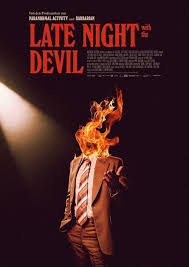
Late Night With The Devil was released in 2024 and written and directed by Colin and Cameron Caines. The independent, supernatural horror movie takes place in 1977 as we follow late night talk show host Jack Delroy hosting a special Halloween themed live broadcast of his show. Over the course of the night Jack has several gifts from a clairvoyant to a magician and finally a young girl who might be possessed by the devil. Over the course of the evening peculiar and terrifying events happen live on television. How much was it real or was it just a trick all along.
For this post, we will be analyzing and discussing two of the characters of this movie. My guest co-collaborator, Spooky Girls Coven Newspaper
, will be writing about Carmichael Haig, a celebrated magician but also a huge skeptic of the paranormal, played by Ian Bliss. I will be writing about Jack Delroy , a late-night talk show host eager to get his show back on track and finally dethrone Johnny Carson as the king of late-night television, played by David Dastmalchian.
The Skeptic in the Room: Carmichael Haig in Late Night with the Devil by Spooky Girls Coven Newsletter
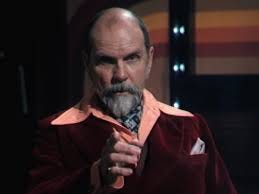
When I first watched Late Night with the Devil, one of the characters that stuck with me the most wasn’t the possessed girl or even Jack Delroy himself. It was Carmichael Haig.
And if you’ve seen the film, you probably know exactly why.
Carmichael Haig, played by the Ian Bliss, walks into the show as the professional skeptic the guy whose entire career is built on debunking psychics, mediums, and supernatural claims. On the surface he feels like the classic “science guy” horror movies often throw in just to argue with everyone. But what makes Haig interesting is that he isn’t just there to say ghosts aren’t real. He represents the audience that wants logic, proof, and control in a situation that’s spiraling into chaos.
And honestly? In the middle of everything happening on that stage, he might be the only person acting rationally.
The whole premise of Late Night with the Devil plays with the idea of spectacle. A late- night talk show chasing ratings during the 1970s decides to lean into the supernatural for Halloween night. Jack Delroy wants a moment that will capture viewers and keep his show alive, and Haig is brought on as the built-in opposition someone who can challenge the paranormal claims and keep things “credible.”
But Haig isn’t just a skeptic. He’s confident, a little arrogant, and absolutely convinced that everything happening can be explained away.
That confidence becomes part of the tension.
Ian Bliss plays Haig with this really commanding presence. When he talks, people listen. When he calls something fake, you almost believe him. He feels like the guy who has spent his entire career walking into rooms full of believers and dismantling their arguments piece by piece.
Which is why watching him slowly lose control of the situation is so satisfying.
What I like about Haig is that he doesn’t feel like a villain. He’s not malicious and he isn’t trying to hurt anyone. In fact, he genuinely believes he’s protecting the audience from manipulation. In his mind, exposing fraud is a public service.
But horror has always loved characters who think they understand the rules of the world… until they don’t.
As the episode progresses and things start to break down, Haig’s certainty starts to crack. The structure he relies on logic, evidence, rationality doesn’t hold up when the show pushes past the point of performance and into something darker. And that’s where the film really shines.
The tension between belief and skepticism becomes the real horror.
In a movie full of performers trying to create a moment for television, Haig is the one person who refuses to play along. He’s constantly pulling the curtain back and asking the question the audience is thinking: what if this is all just a show?
Ironically, that’s what makes him so compelling.
He’s the grounded presence in a film that slowly removes the ground from under everyone’s feet.
And honestly, I think every horror story needs someone like Carmichael Haig the skeptic who walks into the room convinced monsters aren’t real… only to find out the hard way that they might be.
Jack Delroy: A 1970’s Faust by Horror Hangouts
It is one of the oldest cautionary tales in literature, making a deal with the devil in order to achieve instant success. Wagering your soul for instant gratification.
We are all aware of the old story about Faust and The Devil. So much so that the term “making a Faustian bargain’ exists. Jack Delroy in Late Night With The Devil represents a 1970’s version of Faust.
Because of his ambition, Delroy makes a pact with a secret society known as The Owl Cult located in a place called the Grove. As the audience we are unclear of all the details regarding what Jack negotiated for the pursuit of fame. We do know he instantly becomes an overnight success with a popular late-night talk show, ironically enough called The Night Owls, but he never quite achieves the coveted number one spot held by the King of Late- Night, Johnny Carson.
Jack Delroy does find happiness and love as he marries a beloved actress named Madeleine. But things go terribly awry when his wife is stricken with cancer and dies soon afterwords. Could this be part of the bargain? Did Jack know or at least suspect that losing his wife, Madeline, was payment for his success?
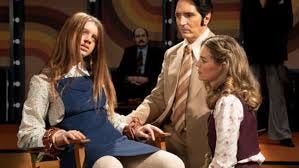
He takes time off from the show but returns. However, the ratings of Night Owls plummet. In a last-ditch effort to save the show, Jack plans a supernatural episode on Halloween night during sweeps week. In the hope that the shows ratings can get a boost and maybe even beet Carson’s show in the ratings, three guests are booked; Christou, a psychic, Carmichael Hague, a magician but also a skeptic who explains away all the tricks that are used, and finally, a young girl named Lilly who is believed to be possessed by the devil and is accompanied by her psychologist and caretaker, Dr. June Mitchell.
The night goes from crazy to bizarre to legitimately scary. At one point, when Christou is attempting to channel spirits on the show, Jack believes his deceased wife is trying to communicate with him, which does leave him unsettled. Does he carry guilt for his wife’s death? Is he even aware that Madeleine’s death was part of the bargain he made at the Grove?
Events become more disturbing when June is able to conjure the demon known as Mr. Wriggles who possesses Lilly and she begins to levitate in the air but what is more distressing for Jack is that Mr. Wriggles seems to know him. Hague proves how this was all a hoax as he accuses June of hypnotizing everyone in to seeing something that never happened as he demonstrates this on Jack’s sidekick, Gus.
But Mr. Wriggles remerges and through Lilly kills June, Gus and Hague as Jack has visions of his late wife, who begs him to kill her to end her suffering but instead Jack kills Lilly with a dagger and awakes to an empty studio with only the corpses of his guests.
I did find the ending to be somewhat confusing. After all since Madeleine had died was that not the price for Jack’s fame. If so why did this demon come after him on this fateful night. Perhaps it had something to do with Jack tempting fate once again. Exploring the world of the paranormal without any concern for the well-being of those involved. Just to get one last chance at success.
When I observe Jack Delroy, I see neither a hero nor a villain at least not intentionally. He does appear to be a decent man who loved his wife very much but at the same time he became so obsessed with fame and fortune, he would discard any concern for himself and those around them to achieve that fame and success. We don’t know the full details of the bargain he made. My guess is, he did not fully understand the consequences of his actions.
It begs the question, what would we do if we had an opportunity at instant success? It is easy to say that we would not have gone as far as Jack. But we are all, also, human and prone to vanity and ego at times.
Jack Delroy is a mirror reflection of society. A society where everyone wants their 15 minutes of fame. We saw that now more than ever in the age of social media where anybody can be famous. What is the price that one is willing to pay and would you be willing to pay. Because that type of success by those means always will burn you in the end. I think that was the point of Late Night With The Devil and Jack Delroy.
 | A guest post by
|
Great review of the move and character analysis. I really liked this movie but, I dont remember how or when I saw it. It just kind of came and went. I hadn't thought of it in a long time.
Loved this review! Totally underrated film, I think.